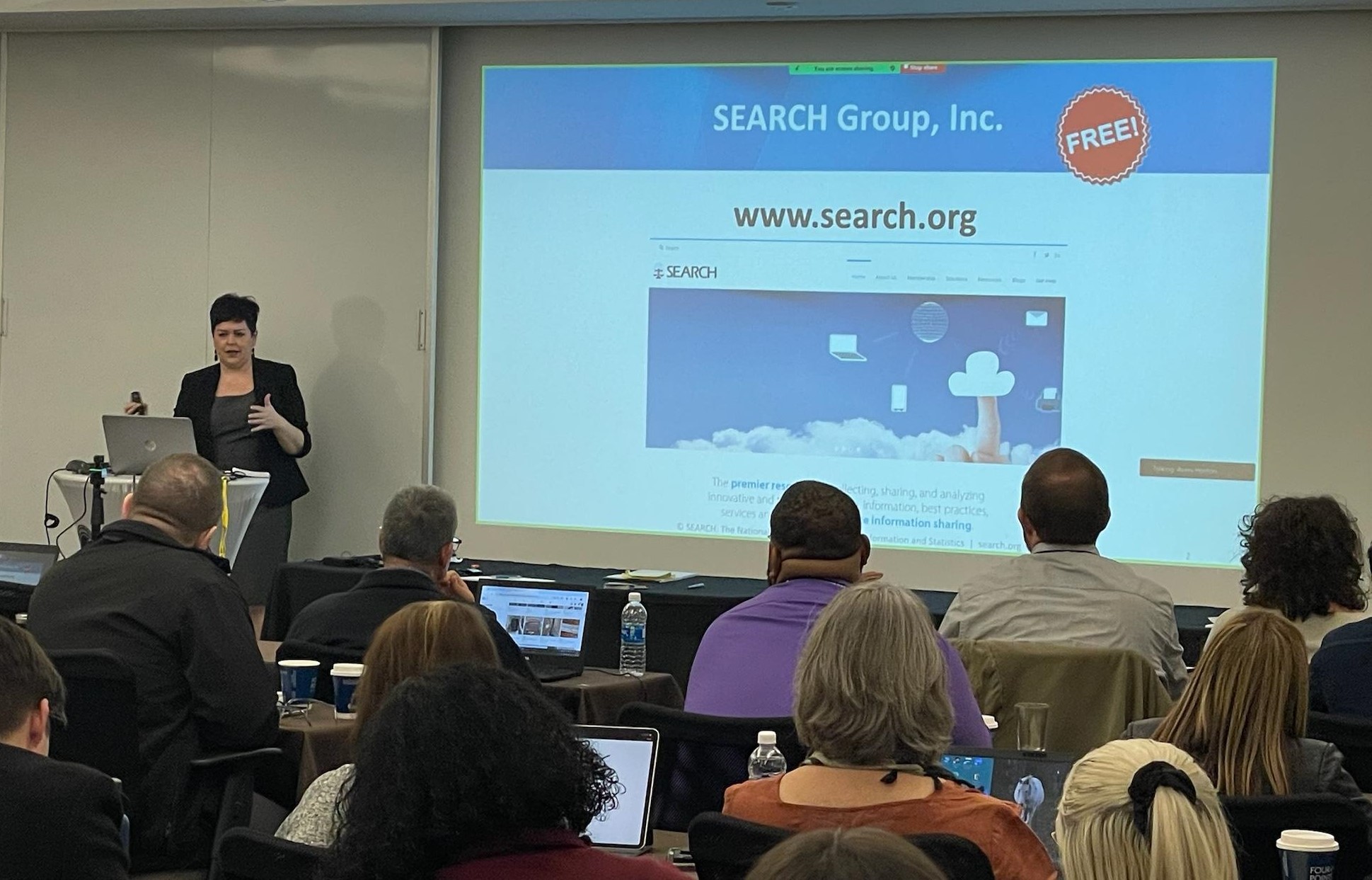
The SEARCH Cybercrime and Digital Forensics team is in Norwood, MA, this week, supporting the National Cyber Crime Conference (NCCC) as both an event partner and training provider.
The NCCC has become one of the premier training events for law enforcement investigators, prosecutors, and forensic examiners in the world. It is hosted by the Massachusetts Attorney General’s Office, and marks its 13th year in 2024.
SEARCH is providing 19 hands-on laboratory sessions and lectures, most of which will also be livestreamed through a virtual conference, to more than 1,000 attendees nationwide.
Of special note, SEARCH is debuting three sessions that address the investigation of artificial intelligence-generated child sexual abuse material (CSAM). According to Lauren Wagner, Program Manager of SEARCH’s Cybercrime and Digital Forensics team, AI is poised to exacerbate the already overwhelmed system of combating online child exploitation.
“As generative AI technology produces increasingly realistic CSAM, new child victims will be created and exploited at an exponential pace. SEARCH is tackling this problem head-on, by developing sessions to demystify this popular technology and explain more effective methods to attack these ground-breaking investigations,” she explained.
SEARCH’s cybercrime and digital forensics experts developed the following training, which is being offered this week at the NCCC:
Artificial Intelligence
AI-Generated Media: Understanding “Alg CSAM” and its Creation
Artificial Intelligence-Generated CSAM or “AIg CSAM” is quickly arriving at jurisdictions nearby. This course teaches how this material is being created using open-source tools to engage in personal use, distribution, and sextortion crimes.
Trainers: Eric Jollymore, Timothy Lott
Investigating Al CSAM: Working the Digital Forensics
Artificial Intelligence-Generated CSAM or “AIg CSAM” is a rapidly evolving landscape. This course explores the different digital forensic artifacts currently known when these tools are being used to engage in AIg CSAM generation or AI-assisted sextortion crimes.
Trainers: Eric Jollymore, Christopher Dale
Unraveling AI and the Technology That Makes Them Work
AI..? GAN..? Diffusion..? GPT..? What do all these terms mean? This lecture lays out the foundations and essentials for understanding how popular AI technologies work. AI-aided exploitation investigations are coming, and investigators must learn how to build that knowledge and experience.
Trainers: Eric Jollymore, Timothy Lott
Searching/Information Gathering
#howdoisearchthat: Built-in Social Media Search Capabilities
Social media sites have some advanced searching capabilities that are unadvertised and underutilized. This hands-on computer lab shows how to leverage the built-in capabilities offered by social media sites to find information on Facebook, Instagram, Snapchat, and more.
Trainers: Lauren Wagner, Christopher Dale
Become a Google Jedi: Searching Social Media (Part 1 & 2)
Google is everyone’s go-to search engine, but most people aren’t utilizing it to the full capability. Google has built-in tools to search particular websites, exact phrases, and within URLs. This hands-on computer lab teaches how to effectively use Google to filter search results to relevant and useable information, specifically as it relates to social media searching. Students will complete hands-on exercises using Google Boolean and advanced Operators. This computer lab will be presented two times during the run of the conference.
Trainers: Lauren Wagner, Eric Jollymore
Information Gathering Using OSINT Resources
This hands-on computer lab introduces third-party Open-Source Intelligence (OSINT) resources for searching for data on people, places, and things. Included topics include people searching resources, cell phone and email lookup tools, and third-party resources to search for Instagram and other social media information.
Trainers: Lauren Wagner, Christopher Dale
Saving Videos From Online Sources
Social media sites are a treasure-trove of evidence, but saving the data can be challenging. This hands-on computer lab demonstrates free, open-source tools that can used to save data specifically around videos. Topics include browsers and add-ons to save videos from TikTok and Snapmap, YouTube-dl for saving other web videos, and VLC for playing and manipulating videos.
Trainers: Lauren Wagner, Eric Jollymore
Investigative & Forensic Tools/Resources/Practices
EXCELerate Your Investigations: Using Excel Effectively (Part 1 & 2)
Microsoft Excel is perhaps one of the most underrated forensic and investigative tools. Excel enables users to sort, organize, filter, simplify and format data. Users can convert between time zones, quickly find information that appears most frequently, or conditionally format data to highlight the most important information. This hands-on computer lab teaches the tips, tricks and tweaks that will make investigations more efficient and more effective.
Trainers: John Trenary, Christopher Dale
I Want it That Way: Data Manipulation and Transformation
Archives and CSVs to JSONs and Zips; from megabytes to gigabytes, digital evidence comes in so many different sizes and formats. This session teaches how to work with popular and obscure formats and get them into something that works best for the investigator.
Trainers: Eric Jollymore, John Trenary
Practical Tools for Data Insights and Analysis
Acquire practical skills to navigate the evolving cybercrime landscape by working smarter, not harder. This hands-on lab explores practical features from free tools to easily use optical character recognition and advanced mouse functions for seamless insights extraction. Trainees will engage in live demos with precise zooming and annotations, effortlessly toggle between scientific and hexadecimal modes for data decoding, and enhance information navigation using a potent indexing and search tool across multiple volumes.
Trainers: John Trenary, Lauren Wagner
Screen-Savvy Strategies: Enhancing Prosecutorial Visuals
This session helps prosecutors delve into the realm of digital visual storytelling, exploring techniques to effectively create and display visual evidence. From mastering video demonstratives to adeptly saving internet videos, creating impactful screenshots, and leveraging AI to explain technical topics, this session promises to elevate prosecutors’ capabilities in leveraging visual aids. Furthermore, participants will uncover the power of free utilities to zoom, highlight, and annotate, thereby unlocking new dimensions of interactive engagement and clarity in legal proceedings.
Speaker: Lauren Wagner
Scripting in the Fast Lane: Writing Scripts with Chat GPT
Discover how ChatGPT can be a game-changer for forensic scripting. Designed for both novice and experts, trainees will learn how to leverage ChatGPT to write code to solve common forensic or investigative challenges. For example, ChatGPT can swiftly generate a script to parse or search a Google mbox file and display the output in a spreadsheet. While ChatGPT doesn’t replace scripting, it can streamline work by providing a starting point to test code and achieve the desired outcome more efficiently.
Trainers: Christopher Dale, Timothy Lott
You Down With OPP (Other People’s Python)?
Python scripts can be intimidating, but need not be. This hands-on computer lab will demonstrate how to identify pre-written Python code that can be easily copied and run to address a variety of investigative needs. The session covers the basics of Python terminology, how to find someone else’s script, and how to run that script investigations.
Trainers: Eric Jollymore, Christopher Dale.
Cyber Investigations & Awareness
Fortifying Your Fortress: Personal Cybercrime Awareness
Cybersecurity awareness and best practices are a critical part to securing your digital identity and personal information. This hands-on computer lab will demonstrate tips and tricks for password creation and management, home network security, and techniques to find and remove online information about you.
Trainers: John Trenary, Lauren Wagner
Introduction to Cybercrime Fundamentals
This hands-on training, designed for new cybercrime investigators, will pull back the curtain in the world of cyber investigations. Oftentimes breaking down an Internet-based investigation into its fundamental parts can seem overwhelming, but this class will take these foundational skills and make them accessible to any investigator. Topics will include high-tech crime terminology, evidentiary artifact awareness, and the basics for cyber investigations.
Trainers: John Trenary, Christopher Dale

Timothy Lott
Director of Digital Forensics and Cybercrime Training
Timothy Lott
Director of Digital Forensics and Cybercrime Training

Lauren Wagner
Program Manager, Cybercrime and Digital Forensics
Lauren Wagner
Program Manager, Cybercrime and Digital Forensics

Eric Jollymore
Assistant Director of Digital Forensics
Eric Jollymore
Assistant Director of Digital Forensics

Det. Christopher Dale
Cybercrimes Training Specialist
Det. Christopher Dale
Cybercrimes Training Specialist